
Sticky Waterfalls Bua Tong by Scooter
Chiang Mai's only climbable waterfall. Ride north, arrive early, and walk up the rock.
Ride north from Chiang Mai and you reach the one waterfall in the region that invites you to climb it rather than just look at it.
Bua Tong Sticky Waterfalls — formally Nam Phu Chet Si National Park — sits about 65-70 km from the Old City. Two route options work. Route 107 north then Route 1414 east is the faster, better-signed option and the one most riders use. The alternative is Route 1001 north through the Mae Jo area — quieter and scenic but less clearly marked for the final approach.
The ride takes you past farmland and through small communities. It is not a mountain route — there are no significant elevation changes and no technical corners. What it delivers is distance, ease, and then a destination that justifies the ride.
The waterfall gets its name from the calcium-rich limestone that has been depositing here for thousands of years. Unlike most waterfall surfaces, which become dangerously slippery with moss and biofilm, Bua Tong’s rock behaves like pumice stone under your feet. You can walk up it. You can climb the tiers with the help of fixed ropes and feel genuinely safe doing it. That is not a small thing in a region full of waterfalls that are off-limits to climb.
Route Snapshot
| Distance | 140 km round trip |
| Riding time | 2-3 hours each way; 3-4 hours at the falls |
| Difficulty | Easy |
| Best departure | 7:00-8:00 AM (arrive by 9:00 AM) |
| Best scooter | 125cc city scooter — any bike handles this |
| Best season | November-February; avoid July-October after heavy rain |
| Best for | First-time visitors, families, nature as an activity |
| Not ideal for | Riders looking for a technical mountain route |
Route Stops
Chiang Mai Old City — Start
Type: Start point Route role: Departure — fill the tank here
Ride north. Fill up before you leave the city — there are no fuel stations between Chiang Mai and Bua Tong on either of the two route options.
Route 107 + Route 1414 — Option A (Recommended)
Type: Transit From Chiang Mai: ~70 km, 1 hour 15 minutes to 1 hour 30 minutes Route: Route 107 north → Route 1414 east toward Mae Taeng → watch for the “airplane cafe” landmark on your left (an aircraft mounted on a rooftop) → Bua Tong junction on your right → follow signs to car park
This is the faster and better-signed option. The road surface is good throughout. Truck traffic picks up after 9:00 AM on Route 107.
Watch for: The airplane cafe landmark. It appears on your left shortly before the turn-off. Once you pass it, the junction is very close.
Route 1001 North — Option B (Scenic)
Type: Transit From Chiang Mai: ~65 km, 1 hour 30 minutes to 1 hour 45 minutes Route: Route 1001 north through Mae Jo area → turn at Ban Pong signs → follow local road to Bua Tong
Quieter, passes rural scenery. Less well-signed for the final approach. Use this if Route 107 is busy or you prefer the slower pace.
Bua Tong Sticky Waterfalls — Must Stop
Type: Natural attraction From Chiang Mai: 65-70 km, 1 hour 15 minutes to 1 hour 45 minutes Why stop: The only climbable waterfall within a reasonable ride of Chiang Mai. Three tiers, fixed ropes, and a lower pool for cooling off. Time to allow: 3-4 hours minimum. Rushing defeats the point. What to bring: Water (at least 1 litre per person — no vendors inside the park), towel, water shoes or grippy sandals, sunscreen, dry bag or waterproof phone pouch.
The lower tier has a natural pool waist-deep at the base — good for swimming. The middle tier is the main photo stop and the steepest section. The upper tier is the highest level; signs indicate where you are advised to stop.
The rock is grippy but not soft. The ropes are fixed but the surfaces between tiers are uneven. Do not push beyond what you are comfortable with.
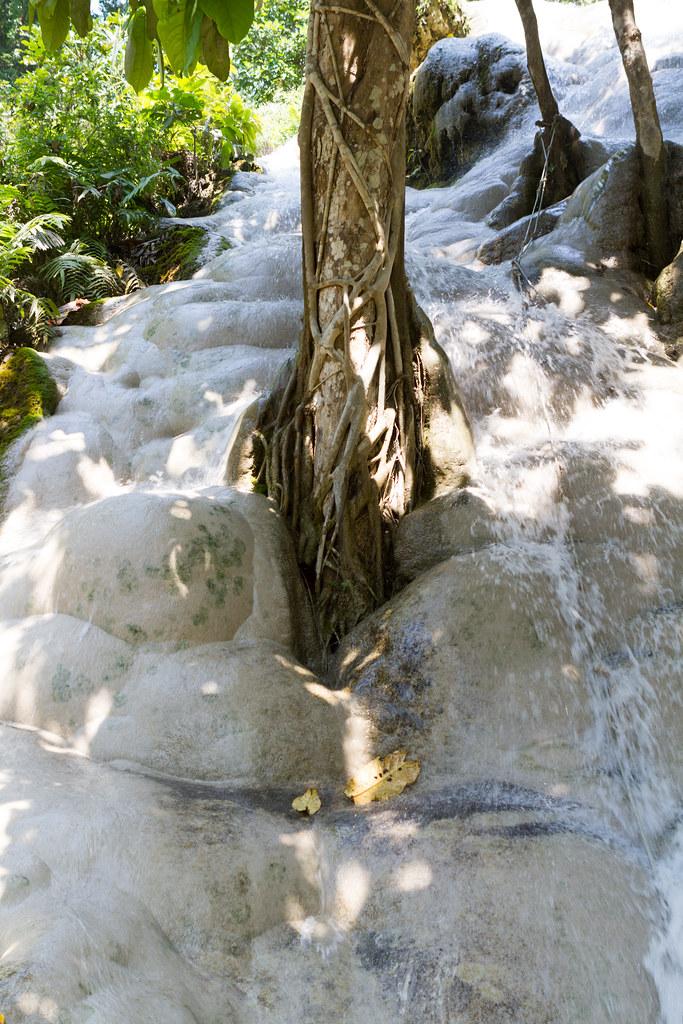
The texture up close: mineral-white limestone deposits with tree roots threading through the flow — this is the surface that grips instead of slipping.
Arrive before 9:00 AM to have the falls mostly to yourself. By mid-morning, tour groups are in full volume.
Parking: Free motorbike bays in the main car park. The car park fills with tour vans from 10:00 AM. Early arrival means you park close; late arrival means a longer walk.
Return to Chiang Mai
Type: End From Bua Tong: 65-70 km, 1 hour 15 minutes to 1 hour 45 minutes Route: Reverse of your chosen approach
The return is the same road in reverse. By this point you have done a 140 km day comfortably on any scooter. A 125cc city bike will have used roughly 3 litres of fuel. You will have plenty of range left.
Scooter Suitability
- 125cc city scooter: Fine for this route — 140 km round trip is well within the range of any 110-125cc. Comfortable at 80-100 km/h on the highway sections.
- ADV 160: More than adequate. The access road’s tighter corners are easier on an adventure bike after rain. Not necessary but capable.
- Touring 300cc+: Comfortable but over-specced for this route. The highway is easy. Save the bigger bike for Samoeng or Doi Inthanon.
What to Check Before You Ride
- Brakes — the access road descent is winding. Functional brakes are essential.
- Horn — the final access road is narrow with limited passing opportunities. A working horn matters here.
- Tyres — check condition before departing. The access road has some rough patches after wet weather.
Combining Stops
Bua Tong is not directly on the Chiang Dao route — they are on different roads. But it combines well with Mae Kampong for a northern circuit day:
- Morning: Mae Kampong (coffee stops, forest walk, village pace) — depart Chiang Mai by 7:00 AM
- Afternoon: Bua Tong — ride north from Mae Kampong (~40 km via rural roads), arrive for a late waterfall climb
- Return: Both routes converge back toward Chiang Mai
The Bottom Line
The tradeoff on this route is distance versus experience. You ride 140 km round trip for a waterfall stop. If you are chasing a serious mountain riding day, this is not it — Samoeng or Chiang Dao deliver more on the riding experience. If you want a satisfying nature stop with a physical element — and the particular pleasure of climbing a waterfall rather than photographing it from a viewing platform — this is the route.
For a traveler’s first experience outside the Chiang Mai city ring on a rental scooter, this is also the one Kai would recommend. The road is simple. The destination is satisfying. The distance is manageable.
Come early. Bring grippy sandals. The rock does not slip.
Related Routes
- Mae Kampong Village Retreat — combines as a morning stop before Bua Tong in a northern circuit day
- Chiang Dao by Scooter — a different northern route for riders who want elevation and open road
- Samoeng Scenic Loop — for riders who want a full mountain day after the waterfall stops
Sources
- WeSeekTravel, “How to Visit Sticky Waterfall from Chiang Mai” (weseektravel.com, accessed 2026-07-05)
- Bon Voyage Thailand, “Bua Tong Sticky Waterfalls Chiang Mai” (bonvoyagethailand.com, published February 2026, accessed 2026-07-05)
- Across Every Border, “Climbing Bua Tong Sticky Waterfall: A Day Trip from Chiang Mai” (acrosseveryborder.com, published May 2025, accessed 2026-07-05)
- Two Wandering Soles, “How to Visit Bua Tong (aka Chiang Mai’s Sticky Waterfall)” (twowanderingsoles.com, published December 2025, accessed 2026-07-05)
- PM Tours, “Sticky Waterfalls Chiang Mai: Climbing Guide & How to Get There” (pm-tours.com, published December 2025, accessed 2026-07-05)
- Tripadvisor, “Bua Thong Waterfalls (Nam Phu Chet Si) Reviews” (tripadvisor.com, accessed 2026-07-05)
- CityGlide, “5 Scooter Trip Ideas Around Chiang Mai” (cityglide.co.th, accessed 2026-07-05)
Photo Credits
ROUTE FILE
Download GPX waypoints
Use this GPX as a planning aid alongside the Google Maps route and on-page notes. Verify the track before riding; road conditions and closures can change.
Download GPXBikago Chiang Mai
A curated synthesis of public information about Bikago Chiang Mai. 5.0/5 across 60 Chiang Mai Google reviews, published motorbike-damage insurance with a USD 95 excess, 24/7 English-speaking helpdesk, roadside assistance, true online booking, and no passport requirement. The main caveat is premium pricing and a smaller local review count than long-established local shops.
91.7 / 100
By Kai Mercer · Updated unknown